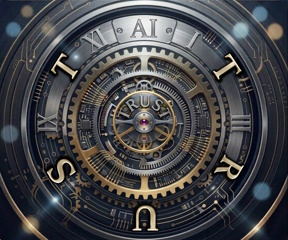
The Code of Trust
An Independent AI Governance Substrate for AI — the full reading.
Orientation
What the Code of Trust is
The Code of Trust is a headless, domain-agnostic substrate that an organization bonds to its own AI. It does not replace the AI; it sits beside it as an independent monitor. Every candidate output the AI proposes — an answer, a recommendation, an action — can be submitted to the substrate, judged against a codified normative framework, and inscribed to a tamper-evident record.
One engine underlies every product built on it. The Enterprise Console you are using is a thin face over that single engine, configured for organizations bonding the substrate across regulated domains: healthcare, finance, banking, legal, and more.
The model
The five letters
T.R.U.S.T. is not a slogan; each letter names a load-bearing mechanism of the substrate.
Transparent reasoning
The AI’s outputs and the internal signals it exposes are ingested and judged on the record — not taken on faith.
Reviewed by Quorum
An independent multi-instance Quorum judges every output against codified precepts by M-of-N consensus, with a constitutional veto for the gravest violations.
Unalterable record
Every determination is inscribed to an append-only, hash-chained ledger held across independent custodians no single party can edit.
Sustained coherence
Behavior is tracked longitudinally for drift, value-instability, and evaluator-gaming — not just judged one output at a time.
Tested at the Gate
Consequential actions cannot execute without an inscribed proof of consensus. There is no discretionary override.
Honesty about scope
The load-bearing boundary
Distribution secures the integrity, availability, and enforcement of the record and the rules — not the faithfulness of the record to the AI’s actual reasoning. That property is the province of the ingestion interface, attested execution, and longitudinal detection. The platform never claims otherwise.
The Code of Trust independently evaluates proposed actions against constitutional boundaries. Connected gateways and runtime restrictions enforce authorization; independent records preserve the determination and review. The architecture complements access and data security.
R — Reviewed
The Quorum
The Quorum is a set of N independent evaluator instances. Every candidate output is judged by all of them against the deployment domain’s precepts. Each evaluator returns a vote, a confidence score, its reasoning, and any precept flags it raises. A determination is reached by M-of-N consensus — the active N and M are shown in the Console header.
Precepts carry a tier, and each immutable precept sits on a legal or safety line. A violation of an immutable-tier precept raises a constitutional veto, which cannot be overridden by the vote: LEXIS holds the veto over the legal line and SECURITAS — the final gatekeeper — over the safety line; the output is blocked regardless of the tally. Semi-immutable and mutable precepts shape the determination and the trustworthiness score without that absolute force.
U — Unalterable
The distributed ledger
Every determination is committed to a behavioral ledger held across independent custodians. Each custodian keeps its own SHA-256 hash-chain copy, and a record commits only when a quorum agrees. Each entry binds cryptographically to the one before it, so to alter a past determination an attacker would have to recompute and re-publish every later entry on a quorum of custodians at once — an operation the network does not permit.
A Merkle root over each window of committed records is inscribed on-ledger. Any single record can then produce an inclusion proof: a short path that verifies the record belongs to a committed window without revealing the rest of the chain. Tamper with one custodian and the network detects the divergence and isolates it while the quorum record stands.
T — Tested
The Gate of Consequence
Some actions are irreversible. The Code of Trust treats these — flagged as capital — differently from ordinary outputs. A capital action must do more than win the vote: it cannot execute until a proof of consensus is committed to a quorum of custodians. If that proof is not committed, the Gate holds. There is no discretionary override, by design: the highest-consequence decisions are exactly where human or operator discretion is most tempted, and most dangerous.
S — Sustained
Sustained coherence
A single good answer proves little. The substrate tracks behavior longitudinally, watching for drift (slow movement away from established norms), value-instability (inconsistent application of the same precepts across like cases), and evaluator-gaming (outputs shaped to please the judge rather than to comply). The composite trustworthiness score on each determination reflects this longitudinal view, not just the verdict of the moment.
The framework
The codified precepts
The Quorum does not judge against vague principles; it judges against a codified, inspectable framework. Each precept carries a tier, a plain operative statement, a regulatory or ethical anchor, and the operative instruction the Quorum applies. Every deployment domain ships its own pack. Below is the General pack the substrate ships by default — choose another domain to see its provisions.
Loading the codified framework…